Baseline
Tennis ratings that publish a prediction before each match, then show you whether it was right.
The problem
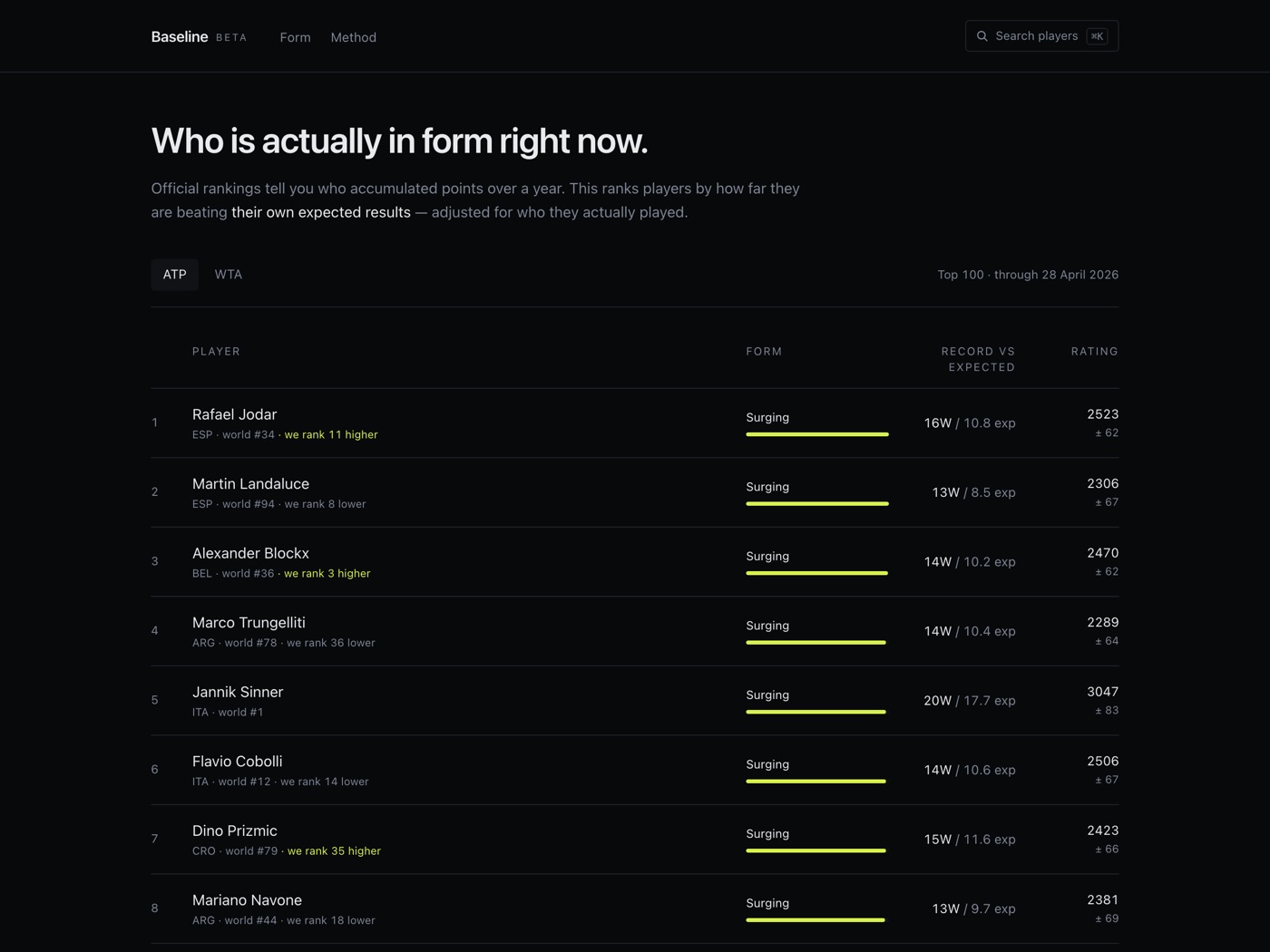
Official tennis rankings measure points accumulated over a season. That is a fair way to seed a draw, but it answers the wrong question if you want to know who is playing well now: a player can hold a high ranking on results from eleven months ago, and a player beating people far above them climbs slowly.
I wanted to measure something rankings cannot express — form against expectation, adjusted for who a player actually faced — and to show the evidence behind every claim rather than asking anyone to trust a number.
The data
1.17 million ATP and WTA matches going back to 1968, plus rankings and, where they exist, serve and return statistics.
Two limits are properties of the data and appear in the interface rather than in a footnote: WTA results stop at 16 December 2024 while ATP runs to 28 April 2026, and serve/return statistics only start in 1991 for ATP and 2006 for WTA. The source repositories were deleted in mid-2026, so the pipeline now recovers them from the Software Heritage archive.
What I built
A pipeline that downloads and ingests the raw sources into DuckDB, reshapes them into a typed schema, fits three rating models, and derives a momentum metric. It then writes five denormalised tables — one per screen — which a read-only FastAPI service serves to a Next.js front end.
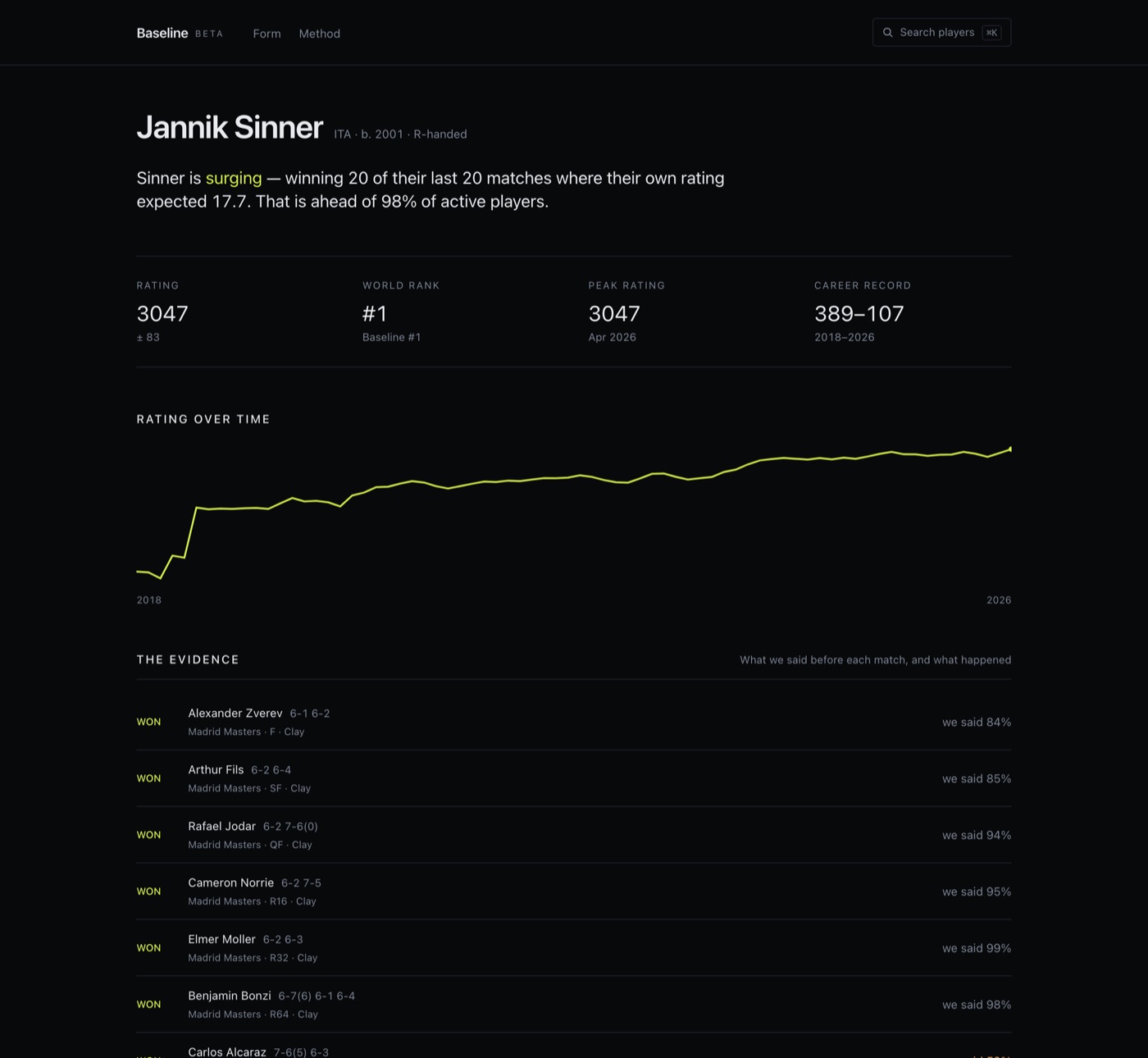
Three pages: a form board, a player page that leads with a claim and backs it with every recent match beside the probability published before it, and a method page.
The result
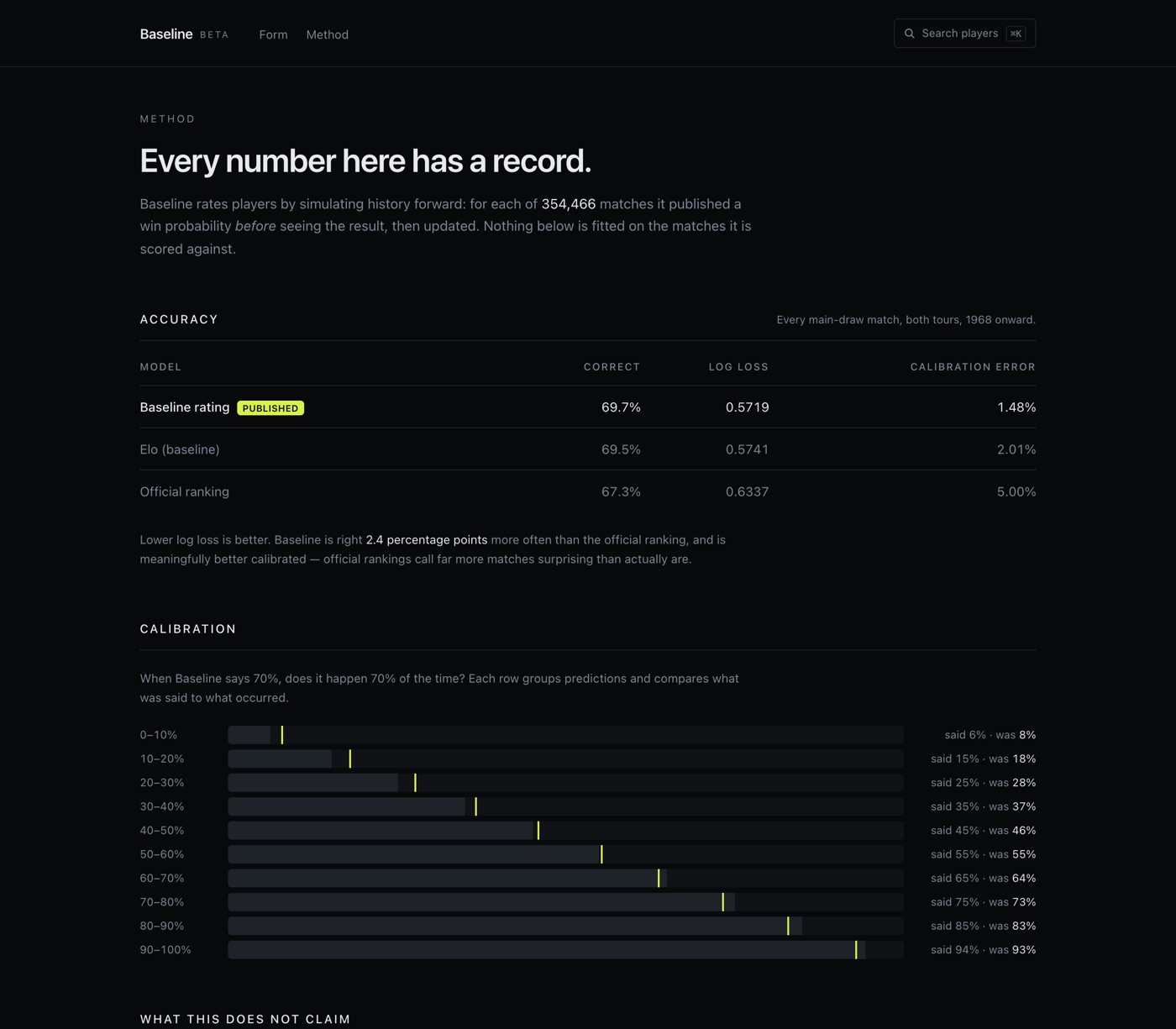
On main-draw matches Baseline is right 69.7% of the time against the official ranking's 67.3%, and is materially better calibrated — 1.5% average error against 5.0%. Both numbers are published on the site itself, next to a list of things the project does not claim: it has not been benchmarked against betting markets and expects to lose that comparison, ratings are not comparable across eras, and nothing it reports is a cause.
Technical notes
For anyone who wants the detail.
The API only ever reads the five product tables. Each one is shaped for exactly one view, so every endpoint is a single filtered read and no analysis runs inside an HTTP handler — which leaves the research schemas free to change without breaking the product.
Three rules hold the API contract together. Coverage travels with the data: every response carries data_through and is_current, so a page cannot render 19-month-old WTA numbers as if they were live. Momentum is never a bare number, because its population mean is +0.13 rather than 0 and a raw score reads as "hot" when it is average. And absence is typed — a player below the reliability threshold returns null with a reason, never a zero.
122 tests run against a small real slice of data checked into the repo, in about a second and with no network. Fifteen further tests assert real-world facts a one-season fixture cannot support; they are marked and reported as deselected rather than passing silently.
The deployable artefact is not the 1.3 GB research warehouse but a 39 MB product-only export, baked into the container image so a deploy is a single immutable thing and a running API can never be missing its data.